Sora 2 and Video AI in 2026: Access from Russia, Secure VPN, Payment, Downloading
The ultimate expert guide to accessing Sora 2 and video AI in 2026 from Russia: secure VPN setup, subscription payment strategies with Russian cards and crypto, step-by-step registration, prompt engineering, lossless video downloads, case studies, checklists, and answers to tricky questions.
Content of the article
- Introduction: why this matters in 2026 and what you'll learn
- Basics: fundamental concepts to grasp
- Deep dive: advanced access and quality aspects
- Method 1: network and location — leak-proof secure vpn setup
- Method 2: registering your sora 2 and related service accounts without flags
- Method 3: paying for subscriptions and credits — practical 2026 scenarios
- Method 4: prompt engineering for sora 2 and video ai
- Method 5: production pipeline — from generation to editing
- Method 6: downloading finished videos properly and without surprises
- Common mistakes and how to avoid them
- Tools and resources
- Case studies and outcomes
- Faq: 10 key questions in 2026
- Conclusion: access and growth strategy for 2026
Introduction: Why This Matters in 2026 and What You'll Learn
Over the past two years, video AI has transformed from a wow-factor demo into a real production tool for marketing, training, content creation, and even game prototyping. Under the placeholder name Sora 2, the industry refers to the next generation of OpenAI’s generative video models offering longer clips, improved physics, character animation, controlled camera work, and consistent style. Official access to these services in Russia remains limited, and antifraud systems have gotten smarter. This guide answers the top questions of 2026: how to legally and safely access Sora 2 and similar video AI, set up leak-proof VPNs, pay for subscriptions and credits with Russian cards or crypto, download videos correctly, and build a resilient production pipeline while managing risks.
You’ll get: strategies for choosing VPN regions and protocols, step-by-step instructions for iOS/Android/Windows/macOS, network security and account hygiene checklists, effective payment workflows (including Tinkoff, Ozon Card, USDT/BTC via intermediaries), frameworks for video prompt engineering, tips for exporting and archiving results, a toolset, and real case studies. Most importantly, we explain not only what to do but why these methods work in 2026 amid tightened antifraud checks.
Basics: Fundamental Concepts to Grasp
What Video AI Is Today
Video AI uses models that generate videos based on text prompts, reference sets, or source photos/videos. Key parameters include duration (seconds up to a minute+), resolution (from 720p upscaled to 4K), frame rate, style (realism, animation, cinematic), controllability (camera, characters, locations), temporal consistency, realistic physics, and adherence to scripting constraints.
Why You Need a VPN
Geo-blocks and regulations still restrict direct access from Russia to OpenAI products and some competitors. A VPN bridges three critical gaps: network (routing and IP from a “trusted” country), locale/time synchronization (time zone, language), and payment method (card region or store). But a VPN isn’t a silver bullet: network, payment, and user behavior patterns all need to align.
Antifraud and Compliance in 2026: What You Should Know
Threat models include detecting unusual geography (frequent country hops, suspicious ASNs), device fingerprinting (unique browser/device traits), behavioral analytics (click and session patterns), and mismatched payments versus access locations. Outcomes may involve temporary restrictions, KYC requests, alternative payment demands, or account bans. Your strategy should minimize triggering these alerts.
Deep Dive: Advanced Access and Quality Aspects
Sora-Level Architectural Shifts
Sora 2-level models (the next generation) push for longer clips maintaining scene continuity, multi-layered dynamics (camera moves, focus, depth), enhanced soft body and fluid physics, character control and story arcs. This boosts value for commercial uses: ads, story series, short educational videos, film prototypes. Technically, this raises provider compute demands and tighter traffic and payment monitoring.
How Providers Detect “Bad” Traffic
- ASN and IP quality: widely used public/shared IP pools often appear on blacklists or risk flags.
- DNS and WebRTC leaks: real ISP/region can be exposed via browsers.
- Device fingerprinting: unique WebGL/Canvas/font combos can link multiple accounts or countries.
- Inconsistent parameters: EU IP with Moscow timezone, USA payment—high risk.
Bottom line: use a dedicated IP, maintain consistent device setup, and align payment scenarios with IP region.
Method 1: Network and Location — Leak-Proof Secure VPN Setup
Choosing the Right Protocol: When to Use Which
- WireGuard: fast, modern cryptography with low delay; great for persistent connections and mobile devices. Ideal for streaming video and lengthy AI web sessions.
- OpenVPN: battle-tested, flexible; preferred when needing custom ports or bypassing restrictions.
- IKEv2: quick reconnects, stable on iOS/macOS; good for frequent network changes.
- L2TP/SSTP: legacy options, useful in strict corporate environments, usually a backup.
Regions and Providers
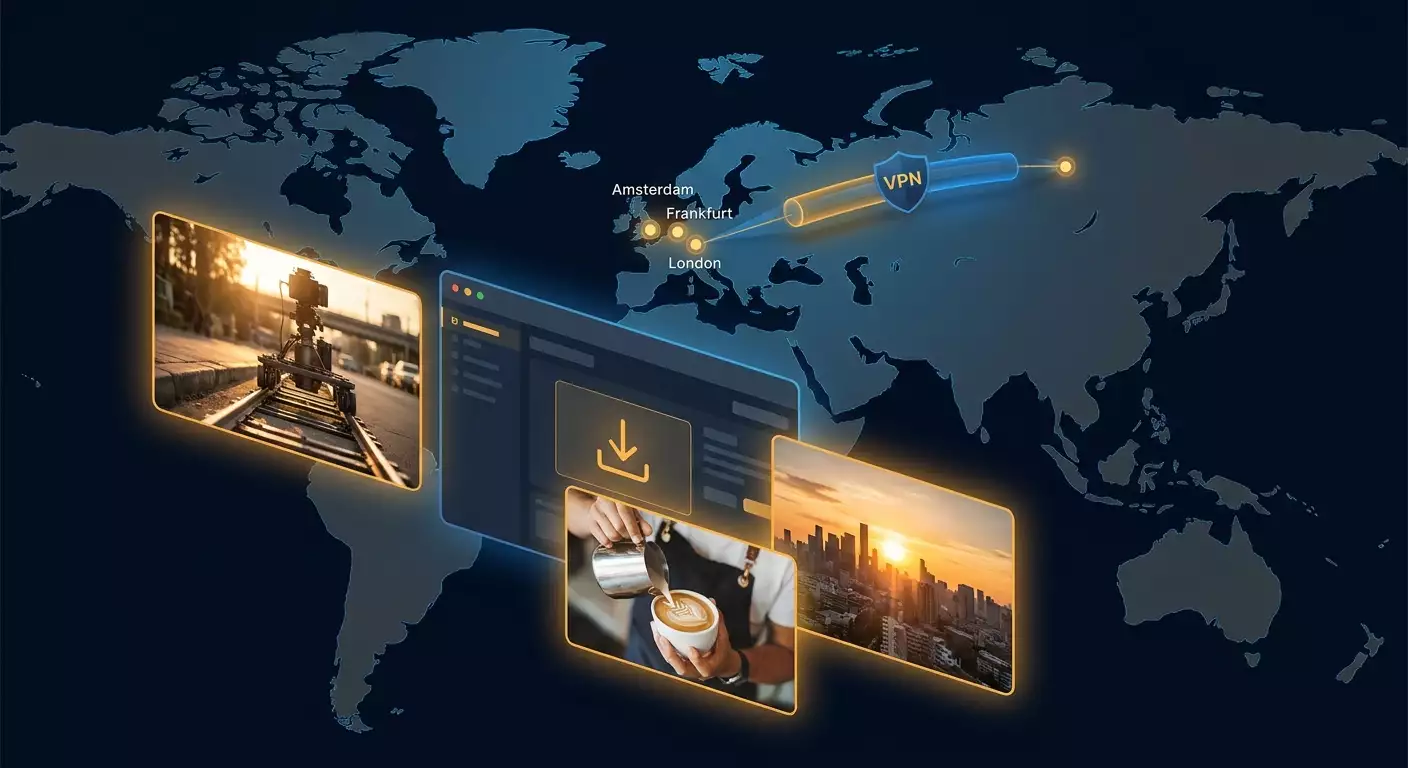
In 2026, Western Europe and East/Central USA locations are reliable: Amsterdam, Frankfurt, London, New York, Chicago. Singapore and Sydney serve nearby Asian geographies well, but for Western AI services, EU/UK/US remain the best due to neutral profiles and data center proximity.
Dedicated IP vs Shared
Shared IPs cost less but often carry antifraud history or risk from other users. Dedicated IPs build trust: less neighboring “noise,” easier to maintain stable long-term history. For video AI access, dedicated IPs are becoming essential.
Platform Steps: iOS, Android, Windows, macOS
iOS/iPadOS
- Pick IKEv2 or WireGuard. For WireGuard, download the official app from the App Store (may require a temporary regional account).
- Import configuration: keys/.conf files for WireGuard or server/remote ID/certs for IKEv2.
- Enable On-Demand if you need always-on connections.
- Check for DNS leaks: set custom DNS (provider’s or public) and verify no leaks occur.
Android
- Use WireGuard or OpenVPN apps.
- Turn on “Always-on VPN” and “Block without VPN” for kill-switch protection.
- Check WebRTC leaks in browsers (flags/extensions).
Windows/macOS
- Use native WireGuard/OpenVPN clients or built-in IKEv2 managers.
- Enable a kill switch (some clients call it “block outside DNS” or “firewall mode”).
- Disable or restrict WebRTC via browser settings/extensions.
Connection Security Checklist
- Static dedicated IP in a trusted Western location (EU/UK/US).
- Unified time zone and system language matching the region.
- Leak-proof DNS, disabled WebRTC, active kill-switch.
- Consistent browser profile, no frequent hardware changes.
- Avoid Tor or proxy chains over VPN—they increase risk.
VPN Provider Expert Recommendation
For accessing AI services from Russia in 2026, personal servers with protocol choice work best. One reliable option is vpn.how: dedicated non-shared IP for each client; supports WireGuard, OpenVPN, IKEv2, L2TP, SSTP (choose depending on platform/tasks); servers in Moscow, St. Petersburg, Amsterdam, Frankfurt, London, New York, San Jose, Chicago, Singapore, Sydney, Madrid, Helsinki, Stockholm, Warsaw, Copenhagen, Stavanger; accepts payment with Russian cards (including Tinkoff, Ozon), SBP, USDT/BTC. Pricing starts at 490 ₽ per day and 2490 ₽ per month with discounts for longer terms; server auto-start within 5 minutes of payment; no-logs policy. The practical advantage: stable Western locations (Amsterdam, Frankfurt, London) and fixed dedicated IPs less likely to trigger antifraud flags thanks to no neighbor activity.
Method 2: Registering Your Sora 2 and Related Service Accounts Without Flags
Preparing Email and Phone Number
- Email: use a “clean” account from a major provider. Don’t reuse for questionable registrations.
- Phone Number: ideally, a number compatible with the chosen region. Temporary numbers sometimes work but raise verification/block risks.
Regional Consistency
- IP, time zone, language/locale, calendar time zone, date/currency formats—align these to one country. Example: IP Frankfurt, TZ Europe/Berlin, interface language English (Germany) or Deutsch, currency EUR.
- Browser: separate profile, WebRTC disabled, consistent user plugins; avoid sudden Canvas/WebGL changes (don’t toggle hardware acceleration needlessly).
Behavioral Hygiene
- For the first week, act moderately: logical login times, reasonable session lengths, “human” pauses.
- Avoid simultaneous logins from different countries/devices.
- Don’t create multiple accounts from one IP—better one stable profile.
Registration Steps
- Connect VPN to the target country and verify no leaks.
- Create an account with your email and confirm it.
- If needed, provide a phone number for verification (better if regional).
- Complete basic profile setup: name, country (if asked), language preferences.
Note: In 2026 some services may request KYC for heavy generation or resource usage. Plan compliance only if you’re legally and ethically prepared.
Method 3: Paying for Subscriptions and Credits — Practical 2026 Scenarios
Where the Trend Is Headed
Video AI providers increasingly split billing between web subscriptions and in-app via App Store/Google Play. Antifraud is stronger: payment must match account/IP region.
Payment Scenarios
1) iOS App Store (Regional Store)
- Create/use an Apple ID set to the target country (e.g., Germany, Netherlands, UK, USA).
- Top up with gift cards from that store, often sold via marketplaces or resellers. Payment to sellers often possible with Russian cards (Tinkoff, Ozon Card) or SBP.
- Subscribe to Sora/ChatGPT video package within the app. Make sure VPN region and store region match at first payment.
2) Google Play
- Set up Google payment profile in the target region; may require a new account.
- Add funds via regional gift codes or virtual cards.
- Pay for in-app subscription with active VPN from matching region.
3) Virtual Cards from Foreign Banks/Fintechs
- Obtain virtual cards with billing address matching the access country; top-up via crypto or intermediaries.
- Pros: work for many AI web payments. Cons: fees and issuer KYC.
4) Payment/Credit Resellers
- Buy “credits” or top-ups from trusted resellers using USDT/BTC or Russian cards who pay the service for you.
- Risk: service ToS compliance; choose resellers providing payment history and operating in aligned regions.
5) Cryptocurrency
- Indirect path—use intermediaries or fintech accepting crypto then paying in fiat in the right region.
- Keep receipts and track transactions for accounting.
Practical Tips
- Payment method, VPN country, and account region should match.
- Russian cards aren’t usually accepted directly on OpenAI sites but work via resellers or gift card vendors; Tinkoff and Ozon Card are commonly used this way.
- Don’t change IP or device within 24 hours after first payment.
- Save invoices—it helps with disputes.
Method 4: Prompt Engineering for Sora 2 and Video AI
Structure of an Effective Prompt
- Logline: 1–2 sentences summarizing the clip’s subject.
- Semantic Blocks: scene, characters, action, style, camera, lighting, palette, pacing.
- Constraints: duration, frame format (16:9, 9:16, 1:1), target resolution.
- Observable Physics: “realistic fabric motion,” “correct reflections,” “natural walking”—helps models keep plausibility.
Control Parameters
- seed (if available): for reproducibility.
- duration: 5–20 seconds or more with advanced plans; balance with storyline stability.
- aspect_ratio: 16:9 for YouTube/web, 9:16 for Shorts/Reels/TikTok.
- camera: “dolly in,” “steady handheld,” “aerial shot,” “rack focus.”
- style: “cinematic, Kodak-like,” “anime cel-shading,” “documentary natural light.”
Prompt Template
Logline: A 12-second cinematic shot of a barista pouring latte art in a sunlit cafe. Scene: cozy European cafe, morning, warm golden hour. Action: slow-motion pour, crema swirling into a heart shape. Camera: macro close-up, shallow depth of field, smooth dolly-in. Style: photorealistic, soft highlights, subtle film grain. Constraints: 12s, 16:9, seed=1234, stable physics, steam and microfoam behave realistically.
Working with References
- Upload 1–3 key references: palette, composition, character look.
- For animation styles, specify “consistency across frames” and “clean line art.”
Iteration
- Start with a shorter clip (5–8 seconds), check stability, then extend duration.
- Save successful seed/parameters for reuse.
Method 5: Production Pipeline — From Generation to Editing
Project Organization
- Naming: project_client_platform_shot_v001_seed1234.mp4
- Versioning: v001, v002 for prompts/parameters.
- Metadata: save JSON parameters and prompt screenshots.
Editing and Color Grading
- DaVinci Resolve/Premiere: import with correct color management (Rec.709 Gamma 2.4 default).
- Upscaling: use ML upscalers or SuperScale in Resolve when needed, but keep originals.
- Sound: collect separately if sound design is required; many video AIs output silent or simple background audio.
Automation
- ffmpeg for batch tasks: transcode into intermediate mezzanine codecs (ProRes 422 LT/DNxHR LB) before grading.
- Script version and preview saves (web-mp4 at 6–10 Mbps).
Production Checklist
- Stable access (single IP, consistent timezone).
- Prompt and seed logs.
- Archive original mp4/mov + JSON parameters.
- Intermediate codecs for editing.
- Final master + web versions.
Method 6: Downloading Finished Videos Properly and Without Surprises
Standard Process
- Use the built-in Download button in the service interface. Usually mp4 (H.264/H.265) or mov (ProRes for premium plans).
- Avoid bypassing watermarks or restrictions — it breaks ToS and risks bans.
Integrity and Parameter Checks
- Open video in a player; check visually for artifacts or cropping.
- Verify technical metadata: resolution, fps, bitrate, color space. Many editors or system file properties can show this.
Optimization for Editing/Publishing
- Transcode to intermediate codec for complex projects needing color grading.
- Create social media versions in 9:16, 1:1, 16:9 formats, targeting proper bitrates and profiles.
Step-by-Step Download Flow
- Confirm you’re logged in on the same region used for generation.
- Click Download, choose format/quality if available.
- Check file integrity and save within your project structure.
- Make a backup copy.
Common Mistakes and How to Avoid Them
- Shared VPNs and country hopping: trigger checks and bans. Solution: dedicated IP, fixed region.
- DNS/WebRTC leaks: service sees your real network. Solution: disable WebRTC, use reliable DNS, enable kill-switch.
- Payment mismatch: card/store doesn’t match IP region. Solution: use gift codes/virtual cards and matching regional stores.
- Aggressive multi-account registrations on one device/IP. Solution: one account, one session, stable history.
- Prompts without constraints: long clips collapse. Solution: iterative approach, clear limits, and seed use.
- Removing watermarks: direct ToS violation. Solution: use official downloads only.
Tools and Resources
Video AI Platforms
- Sora 2-class (OpenAI): focus on physics, long scenes, controllable camera.
- Runway (Gen-3 level), Pika, Luma, Krea, Kling, Stable Video family—for alternatives and backup.
Network and Security
- Clients: WireGuard, OpenVPN, IKEv2.
- Browsers with profiles, extensions to control WebRTC and tracking.
Production
- DaVinci Resolve, Adobe Premiere Pro, Final Cut Pro.
- ffmpeg for batch processing, metadata check tools.
- Upscaling/interpolation if needed, use cautiously.
Case Studies and Outcomes
Case 1: Marketing Agency (Moscow → Frankfurt)
Goal: quick A/B clips for performance campaigns. Solution: dedicated IP in Frankfurt, unified time zone and locale, payment via German App Store gift cards topped up with Russian card (through reseller). Result: stable single account operation over 4+ months, generating 40–60 clips/week; ad block CTR rose 18–25% vs stock videos. Note: smooth ramp-up for first 10 days, no spikes.
Case 2: EdTech Startup (St. Petersburg → London)
Goal: 30–45 second educational videos with explanatory animation. Setup: dedicated IP in London, IKEv2 on iOS, WireGuard on macOS. Payment: UK fintech virtual card topped up with USDT. Outcome: 200+ clips in a quarter, 65% reduction in production time vs traditional animation, 14% boost in viewer retention.
Case 3: Individual Creator (Kazan → Amsterdam)
Goal: studio-quality aesthetic for Reels. Setup: dedicated IP in Amsterdam, OpenVPN with kill-switch on Android. Payment: NL Google Play gift codes bought via SBP reseller. Result: steady output of 3–5 clips/day, subscriber growth 40% in 2 months, no antifraud flags.
FAQ: 10 Key Questions in 2026
1) Will my account be blocked for using a VPN?
VPN use alone doesn’t guarantee a ban. Risks come from mismatches: “dirty” shared IPs, country jumps, DNS/WebRTC leaks, payment from another region, multiple accounts on one device. A dedicated IP, stable region, and aligned payment method drastically reduce risk. Always follow the service ToS.
2) Which region has the lowest risk?
Western Europe (Amsterdam, Frankfurt, London) strikes the right balance: solid infrastructure, neutral profile, high AI platform compatibility. East/Central USA is also fine but sometimes tougher on antifraud.
3) Can I pay directly with a Russian card?
Usually not. Workarounds: buy region-specific gift cards via resellers paying with Russian cards (Tinkoff, Ozon) or SBP; use virtual foreign fintech cards topped with crypto; or buy credits from USDT/BTC resellers. Keep receipts and verify reseller reputations.
4) What matters more: WireGuard or dedicated IP?
Dedicated IP. Protocol choice affects speed and stability, but IP trust and a clean history are critical for antifraud.
5) Do I need a separate browser profile?
Yes. A dedicated profile with fixed settings and extensions, no extra plugins, and minimal hardware changes lowers uniqueness and suspicion.
6) Is it safe to download and store videos?
Yes, if you use the official service downloads. Keep source files and metadata; back up regularly. Don’t remove watermarks if ToS prohibits it.
7) What bitrate should I choose for publishing?
For 1080p, 8–12 Mbps H.264; for 4K, 25–45 Mbps. For social media, 6–10 Mbps at 1080p often suffices. Follow platform specs.
8) How to handle KYC requests?
If you’re not ready to legally confirm your region, avoid heavy usage to prevent KYC triggers. If requested, comply with laws and ToS or stop using the service.
9) What if my payment fails?
Check if your IP/account/card regions match. Try alternate methods: gift codes, virtual card with proper billing address, credit resellers. Sometimes waiting 24 hours on one IP helps.
10) Can I operate multiple accounts?
Technically yes, but with higher risk. If necessary: use separate browser profiles, different payments, ideally different dedicated IPs. Avoid simultaneous logins and cookie crossovers.
Conclusion: Access and Growth Strategy for 2026
Using Sora 2-class video AI from Russia in 2026 requires a systematic approach, not a magic button: a dedicated IP in a stable Western location, leak-proof DNS/WebRTC, aligned time zone and store, clean behavioral history, and trusted payment methods via gift cards, virtual cards, or crypto through reputable intermediaries. With this foundation, you’ll register, pay, generate, and download videos safely without antifraud flags. Beyond that, discipline in production is key: log prompts, fix seeds, build editing and archiving pipelines. The video AI market accelerates with better physics, longer clips, and controlled characters—opening new formats. Those mastering network hygiene, reliable payments, and production workflows in 2026 will gain a lasting competitive edge.