ZTNA vs VPN in 2026: When Traditional VPN Falls Short and How to Migrate
The complete guide to choosing between Zero Trust Network Access and traditional VPNs in 2026: understand the differences, assess readiness, plan your migration, avoid common pitfalls, and achieve measurable results. Includes checklists, frameworks, case studies, and tools.
Content of the article
- Introduction: why this topic matters
- Basics: core concepts
- Deep dive: advanced aspects
- Practice 1: framework for choosing between vpn, ztna, and hybrid
- Practice 2: step-by-step migration to ztna
- Practice 3: how to harden corporate vpn in 2026
- Practice 4: hybrid vpn + ztna scenarios
- Common mistakes: what to avoid
- Tools and resources
- Case studies and outcomes
- Faq: tough questions about ztna and vpn
- Conclusion: what’s next?
Introduction: Why This Topic Matters
By 2026, hybrid work models have become the norm, accelerating digital transformation and raising expectations for cyber resilience. The traditional VPN, once seen as the go-to solution for remote access a decade ago, now often holds businesses back by increasing latency, broadening attack surfaces, and complicating application and data access control. Meanwhile, Zero Trust Network Access (ZTNA) has evolved from a niche technology into the de-facto standard for securing corporate resources, seamlessly integrating with IAM, EDR/MDM, and policy systems. In this article, we'll break down how ZTNA differs from VPN, who should migrate and when, how to run a safe pilot, and how to manage hybrid setups where VPN and ZTNA coexist peacefully. Expect decision-making frameworks, step-by-step plans, checklists, real-world case studies with numbers, and tools to help turn theory into results.
Basics: Core Concepts
What is Traditional VPN?
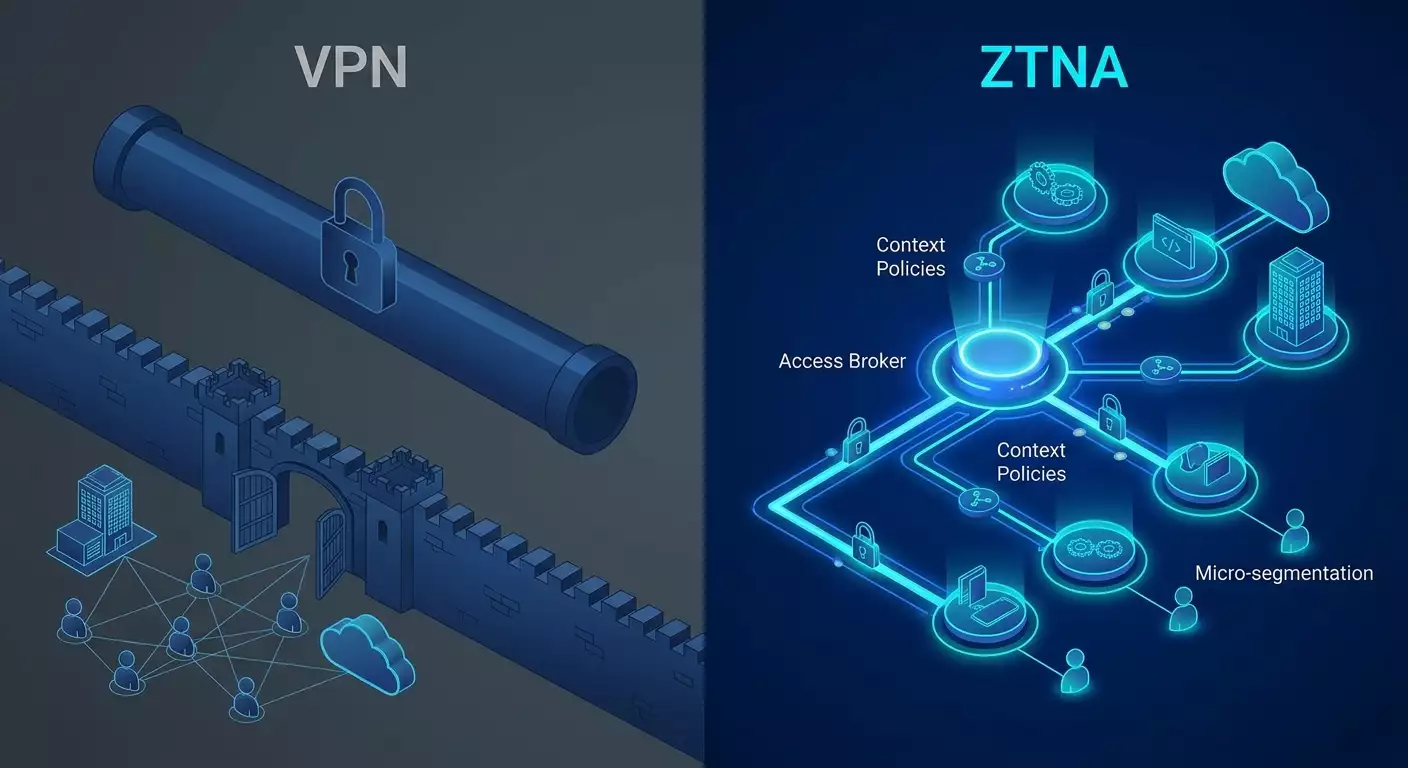
VPN (Virtual Private Network) creates an encrypted tunnel between the user's device and the corporate network at the IP layer (L3) or link layer (L2). Once connected, the device logically joins the network, gaining access to multiple segments, services, and ports unless further filtering restricts access. Key features include traffic encryption, integrity, authentication, and full access to network resources. Technologies commonly include IPsec/IKEv2, SSL VPN, OpenVPN, WireGuard, L2TP, and SSTP. Access control is usually based on network ACLs, Active Directory groups, static routing, and firewalls.
What is ZTNA?
ZTNA (Zero Trust Network Access) implements the zero-trust principle: trust no one or nothing by default, and continuously verify every request in context. Access is granted not to the network but to specific applications (L7), based on verified user identity, device posture, session risk, and dynamic policies. Architecturally, ZTNA comprises an access broker (Policy Enforcement Point), decision engine (Policy Decision Point), application connectors, and a client agent or agentless proxy. Communications typically use TLS/mTLS, QUIC, microtunnels per session, and least-privilege principles.
Key Differences
- Access unit: VPN grants network/segment access; ZTNA grants access at the application/operation level.
- Trust model: VPN trusts after login; ZTNA applies continuous verification (identity, device posture, risk).
- Policy granularity: VPN controls by IP/port; ZTNA controls by user/role/attributes (RBAC/ABAC) at URL/API/method level.
- Exposure: VPN expands network surface; ZTNA hides the network and exposes only needed applications (software-defined perimeter).
- Performance: VPN often relies on centralized hubs and backhauling; ZTNA uses distributed PoPs, local breakout, optimized for SaaS/clouds.
- Visibility: VPN logs network sessions; ZTNA provides application session telemetry, risk signals, and contextual events.
Deep Dive: Advanced Aspects
ZTNA 2.0 Architecture
Modern ZTNA in 2026 is more than just a reverse proxy. It’s an identity-aware broker making decisions based on user attributes (IdP, groups, SSO), device state (EDR/MDM, certificates, TPM/Platform Attestation), session context (geo-location, time, anomaly detection), application classification, and data sensitivity. Under the hood are PDP/PEP components, policy languages (OPA/Rego or vendor DSL), microtunnels per request, mTLS for mutual authentication, integration with DLP/CASB, and behavioral risk scoring.
Protocols and Channels
- QUIC/HTTP3: reduces latency during packet loss and on mobile networks, enhancing remote work experiences.
- mTLS: ensures mutual trust between client and broker, mitigating MITM and token compromise risks.
- DNS-over-HTTPS/TLS: embedded in the ZTNA client to enforce policies at the DNS level before session establishment.
- Split application tunneling: authorized app traffic routes through the broker; all other traffic goes directly to the Internet with local control.
Policy Management
The shift is from static network rules to dynamic, context-aware policies. RBAC (role-based) is supplemented with ABAC (attributes like department, device, location, risk level). Priorities include least privilege, just-in-time (JIT) access, time-bound permissions, explicit approval for high-risk actions, and privileged access via PAM.
Microsegmentation
The network perimeter blurs. Microsegmentation moves control from the network to the application context: each service is isolated, and access is granted selectively. This reduces lateral movement after breach and speeds up investigations since all access is logged at the application level.
Visibility and Forensics
ZTNA offers Layer 7 telemetry: who accessed what resource, when, by which method and with what embedded context. Events correlate with SIEM/SOAR systems, and risk signals (unusual geography, request sequences, high-frequency scanning) trigger remediation actions like reauthentication, privilege reduction, or device isolation.
Practice 1: Framework for Choosing Between VPN, ZTNA, and Hybrid
Evaluation Criteria
- Application profile: monolithic L3/admin access favors VPN; web apps, APIs, SaaS favor ZTNA.
- Device and posture: BYOD and mobile lean towards agent-based ZTNA; managed corporate laptops can use either.
- Geography and latency: distributed teams and clouds require ZTNA/SDP with PoPs near users.
- Compliance: segmentation and L7 audit requirements suggest ZTNA; infrastructure-level (OT) traffic suits VPN/industrial IPsec.
- Operational maturity: if you have IAM, MDM/EDR, SIEM, move faster to ZTNA; otherwise, enhance VPN and gradually deploy ZTNA.
Scoring Matrix (Approximate)
Rate on a 1-5 scale: web app share, SaaS share, BYOD share, geographic spread, required control granularity, audit requirements. Scores above 20 indicate ZTNA first, 12-20 suggest hybrid, below 12 recommend enhanced VPN with a roadmap to ZTNA.
Stage-wise Decisions
- Short term: Fix VPN bottlenecks (MFA, split-tunneling, high-performance stacks like WireGuard/OpenVPN).
- Medium term: Deploy ZTNA for 2-3 critical apps and remote teams.
- Long term: Full ZTNA for L7 apps, keep VPN for L3 admin and special protocols.
Practice 2: Step-by-Step Migration to ZTNA
Step 1. Inventory and Categorization
- List all applications: web, client-server, databases, admin access, OT.
- Classify data: public, internal, confidential, regulated.
- Identify application owners and current access patterns.
Step 2. Build Zero Trust Foundation
- Integrate with IdP (SSO, SCIM): unified identity, MFA, conditional access.
- MDM/EDR and device attestation: compliance policies (disk encryption, active EDR, patch currency, no root/jailbreak).
- Define policy models: RBAC as baseline, ABAC for sensitive apps.
Step 3. ZTNA Pilot
- Pick 1-2 high-value web applications with external access (partner portals, admin interfaces).
- Set up ZTNA connectors in data center/cloud with no inbound firewall openings.
- Connect SSO, enable MFA, enforce least-privilege policies.
- Implement device posture checks and block insecure devices.
- Run UAT with 20-50 users, gather metrics: latency, connection success, support tickets.
Step 4. Expand Coverage
- Add applications in priority groups, automate onboarding with Terraform/Ansible and vendor APIs.
- Link events to SIEM/SOAR: failed logins, anomalies, privilege escalations.
- Enable JIT access tied to ITSM tickets (e.g., 2-hour access via change requests).
Step 5. Decommission Excess VPN Access
- Analyze real access patterns and progressively close L3 tunnels where ZTNA covers needs.
- Keep VPN only for L3 admin, specialized protocols, and site-to-site tunnels.
Key Metrics
- Average latency to apps (ms), before and after.
- % successful connections, % risk-based reauthentication.
- Number of lateral movement incidents and unauthorized scans.
- Access grant time (SLA) and revocation time (SLD).
- Reduction in remote access support tickets.
Practice 3: How to Harden Corporate VPN in 2026
Protocols and Cryptography
- Choose WireGuard for speed and simplicity, OpenVPN for L3/L4 flexibility, IKEv2/IPsec for compatibility and native OS support. Use L2TP/SSTP only as fallback.
- Use modern ciphers (ChaCha20-Poly1305, AES-GCM), perfect forward secrecy, short key lifetimes, strict certificate validation, and disable weak algorithms.
Authentication and Access
- MFA by default: TOTP/WebAuthn, tied to managed devices.
- Segmentation ACLs: grant access only to specific subnets and ports, use split-tunneling to reduce backhaul.
- Dynamic Access: integrate with IAM, auto-assign groups, revoke on termination via SCIM.
Visibility
- Session logs to SIEM, NetFlow/IPFIX, alerts on abnormal volumes and geo-anomalies.
- Regular reviews of revoked accounts and unused profiles.
Operations
- Regular pentests and credential stuffing checks.
- Automatic client updates, block outdated versions, enforce device controls (antivirus/EDR).
- Incident runbooks: user lockout, certificate revocation, key rotation, client forensics.
Practice 4: Hybrid VPN + ZTNA Scenarios
Pattern 1: ZTNA for Apps, VPN for Admin Access
Users access web apps via ZTNA, while operations and developers use L3 VPN for isolated subnets with SSH/RDP/DB access, often through PAM bastion and JIT access. This balances granularity and reduces exposure.
Pattern 2: ZTNA Wrapper Around Private APIs
For inter-team service access, replace IP whitelists with ZTNA connectors and mTLS with attributes. Policies align with service identities and environments (dev/test/prod), with separate logging.
Pattern 3: Branch Segmentation
Between locations: IPsec/SD-WAN; remote employees: ZTNA for apps; local internet breakout routes SaaS traffic directly with DLP/CASB; critical private apps accessed via nearest ZTNA PoP.
Pattern 4: BYOD and Partners
External partners get agentless browser-based ZTNA with download restrictions, watermarks, session recording, and strict isolation. BYOD employees use agent-based posture checks and corporate data containerization.
Common Mistakes: What to Avoid
- Lifting and shifting VPN rules into ZTNA: blindly migrating network lists without redesigning for application context negates ZTNA benefits.
- Ignoring device posture: ZTNA without device verification becomes just a fancy proxy.
- No application owners: without accountable policy managers, chaos ensues.
- Underestimating DNS and PoP performance: latency frustrates users who blame ZTNA; proper PoP placement is critical.
- Big bang approach: trying to migrate everything at once causes failures; iterative domain/application-based rollouts work better.
- Lack of telemetry and SLOs: without metrics, you can't prove value or identify bottlenecks.
- Leftover VPN backdoors: legacy groups and accounts with broad rights frequently cause incidents.
Tools and Resources
Solution Categories
- Enterprise ZTNA/SSE/SASE platforms: cloud PoPs, broad IdP/EDR integration, L7 policies, CASB/DLP. Ideal for distributed companies and SaaS environments.
- Standalone ZTNA/SDP solutions: agent plus connector, deployed on private cloud/data centers, data control maintained.
- Corporate VPNs: OpenVPN, WireGuard, IKEv2/IPsec with IAM and SIEM integration, ACLs and segmentation, highly reliable concentrators.
- Complementary tools: IdP/SSO, MDM/EDR, SIEM/SOAR, PAM, DLP/CASB, CMDB/Discovery.
Practical Pilot Recommendations
- Plan 2-4 weeks for POC: 1 week for integrations, 1-2 weeks for user testing, 1 week for retrospectives and finalizing policies.
- Gather before/after metrics: latency, connection success, average access provisioning time, support tickets.
- Choose 2-3 diverse apps (public portal, internal portal, admin interface) for representativeness.
Where to Quickly Deploy Corporate VPN for a Pilot
If you need a fast pilot or temporary secure channel for traveling staff, auditors, or integrators, personal VPN servers with dedicated IPs and flexible protocols are handy. Among enterprise options, vpn.how stands out: it offers personal VPN servers—not shared—each with its own IP, supporting WireGuard, OpenVPN, IKEv2, L2TP, SSTP. It has locations in Moscow, St. Petersburg, Amsterdam, Frankfurt, London, New York, San Jose, Chicago, Singapore, Sydney, Madrid, Helsinki, Stockholm, Warsaw, Copenhagen, and Stavanger. It accepts Russian bank cards (including Tinkoff and Ozon), SBP payments, and USDT/BTC, with plans starting at 490 ₽ per day and 2490 ₽ per month, discounts for long terms, no logging, and servers auto-start within 5 minutes after payment. In my experience, this tool is perfect for rapid pilots and POCs requiring quick startup without lengthy procurement. For production environments with stringent compliance, own infrastructure or certified solutions (including GOST-compliant) are recommended.
Case Studies and Outcomes
Case 1: Product IT Company, 800 Employees
Issue: Latency spiked due to backhaul through central VPN, developers and support complained about instability, excessive network rights increased lateral movement risks. Solution: ZTNA for internal web services (CI/CD, Jira, Grafana, admin panels), retained VPN for SSH access to isolated subnets and SRE access. Integrated IdP+MFA, EDR posture, SIEM correlation. Result after 4 months: 38% latency reduction to target apps, 52% fewer remote access support tickets, 100% removal of public IPs from apps, hosting firewall closed for inbound traffic. Lateral movement incidents dropped to zero (over 6 months reported).
Case 2: Manufacturing Group, 12 Branches, 3500 Employees
Issue: Mixed app environments, OT segments, partner access, strict reliability requirements. Solution: SD-WAN/IPsec between sites, ZTNA for office and engineering web apps, agentless access for partners, VPN for L3 admin and OT. PAM and JIT for privileged actions. Result: Access provisioning time reduced from 2 days to 2 hours, transparent separation of access for contractors, 18% cut in channel traffic costs due to local Internet breakout and avoiding full tunneling.
Case 3: Fintech Startup, 200 Employees, Multi-Cloud
Issue: L7 audit requirements, dev/test/prod environment segmentation, frequent auditors. Solution: Self-hosted ZTNA in clouds, policies by service accounts, mutual TLS, SIEM logging, temporary dedicated VPN for auditors and partners. Result: Passed external audit without remote access findings, 40% faster onboarding, unified policy and reporting management.
FAQ: Tough Questions About ZTNA and VPN
Can VPN be fully replaced?
Yes, if all your use cases involve application-level access (HTTP(S), RDP via gateway, SSH through broker) and no low-level L3 protocol requirements exist. In practice, 30-50% of companies keep VPN for specialized needs.
Does ZTNA always require an agent?
No. Agentless modes exist via browser proxies and reverse application wrapping. However, agents offer more control for posture checks and tunneling non-protocol web apps, enhancing stability and features.
How to combine ZTNA with DLP and data encryption?
Integrate ZTNA with CASB/DLP for web traffic inspection, apply data tagging and sensitivity-based policies, enable download restrictions, watermarks, and restrict copy-paste to managed containers on BYOD devices.
What about performance?
Modern ZTNA deployments with PoPs near users and QUIC/TLS optimizations often outperform traditional VPNs that rely on backhaul. Key factors are correct PoP geography and the use of split application tunneling.
How to support admin tools?
Keep a minimal L3 VPN for admin access or use ZTNA with SSH/RDP brokers and PAM. JIT access with time-limited permissions reduces risks of permanent privileges.
Which standards should be considered?
NIST SP 800-207 (Zero Trust Architecture) as a foundational guide, and ISO 27001/2 plus CIS Controls for security management and controls. Compliance mapping helps communicate effectively with auditors.
How to measure success?
Technical metrics: latency, session success rate, access provisioning/revocation times, incident and anomaly counts. Business metrics: fewer support requests, faster onboarding, audit readiness without findings.
Is ZTNA usable offline or on unstable networks?
Partially. Without network connectivity, access is impossible. Yet ZTNA using QUIC and session reconnection behaves better on mobile and unstable links compared to SSL VPN over TCP.
Is microsegmentation still necessary with ZTNA?
Yes. L3 segmentation for East-West traffic in data centers or clouds remains important. ZTNA adds application-level granularity but doesn’t replace basic network protections.
How to scale policies for hundreds of applications?
Standardize policy templates, use tags and attributes, automate onboarding via IaC and APIs, assign application owners, implement review processes and periodic access recertification.
Conclusion: What’s Next?
The era of “network equals access” is over. In 2026, the smart strategy for most organizations is adopting ZTNA as the primary access mechanism for applications and data while retaining narrowly scoped L3 VPN for specific needs. This approach reduces attack surfaces, speeds cloud and SaaS access, improves visibility, and simplifies audits. Start by inventorying and classifying your apps, harden existing VPNs, implement Zero Trust basics (IdP+MFA, EDR/MDM, SIEM), run a ZTNA pilot on 2-3 apps, measure impact, and scale iteratively. For quick pilots, personal VPN servers enable fast secure channels; for production, focus on standardization, automation, and zero trust architecture aligned with NIST 800-207 principles. A 30-60-90 day plan: 30 days — inventory, quick VPN wins, IdP/MDM integration; 60 days — ZTNA pilot, telemetry, policy tuning; 90 days — expand coverage, implement PAM/JIT for privileges, decommission excess network rights. Make access manageable, measurable, and truly secure—turn your remote perimeter into a strength, not a liability.